Note
Go to the end to download the full example code
Self Consistent (SC) Estimation
import numpy as np
import matplotlib.pyplot as plt
plt.rcParams['font.size']=14
plt.rcParams['font.family']='arial'
import rockphypy # import the module
from rockphypy import EM
Dilute distribution of spherical inclusion without self consistency
the coefficients of Eshelby tensor S1 and S2 are functions of the matrix Poisson’s ratio
As a special case, let all micro-inclusions have the same elasticity, with the common bulk and shear moduli \(K_i\), If the macrostress is regarded prescribed, then
and and if the macrostrain is regarded prescribed:
Self consistent estimates
If the distribution of micro-inclusions is random and the interaction effects are to be included to a certain extent, then the self-consistent method may be used to estimate the overall response of the RVE. Now \(S_1\) and \(S_2\) are defined in terms of the overall Poisson ratio
When all micro-inclusions consist of the same material, denote their common bulk and shear moduli by \(K_i\), then
It is noted that although \(\bar{K}\) and \(\bar{G}\) given by dilute distribution estimates are decoupled, by self consistent estimates are coupled, so iterative solver is invoked in SC approach.
Example
Let’s compare the Dilute distribution/ Non interacting estimates to the SC estimation for spherical inclusion. The overall bulk and shear moduli of the media with randomly distributed spherical inclusion sastifies Ki/Km= Gi/Gm=50, \(\nu_i=\nu_m=\frac{1}{3}\)
#  Specify model parameters
ro=13/6
Km, Gm=3*ro, 3 #
Ki, Gi=Km*50, Gm*50  #  65, 30
f= np.linspace(0,0.4,100)
iter_n= 100
#  Dilute distribution of inclusion without self consistency
K_stress, G_stress= EM.SC_dilute(Km, Gm, Ki, Gi, f, 'stress')
K_strain, G_strain= EM.SC_dilute(Km, Gm, Ki, Gi, f, 'strain')

#   Self Consistent estimates
Keff,Geff= EM.SC_flex(f,iter_n,Km,Ki,Gm,Gi)

# plot
fig=plt.figure(figsize=(6,6))
plt.xlabel('f')
plt.ylabel('K_{eff} GPa')
plt.xlim(0,0.4)
plt.ylim(0,4)
plt.title('self_consistent model comparision')

plt.plot(f,K_stress,'-k',lw=2,label='Macrostress prescribed')
plt.plot(f,K_strain,'--k',lw=2,label='Macrostrain prescribed')
plt.plot(f,Keff/Km,'-r',label='SC')

plt.legend(loc='best')
fig=plt.figure(figsize=(6,6))
plt.ylim(0,4)
plt.xlim(0,0.4)
plt.xlabel('f')
plt.ylabel('G_{eff} GPa')
plt.plot(f,G_stress,'-k',lw=2,label='Macrostress prescribed')
plt.plot(f,G_strain,'--k',lw=2,label='Macrostrain prescribed')
plt.plot(f,Geff/Gm,'-r',label='SC')
plt.legend(loc='best')


<matplotlib.legend.Legend object at 0x000002132B69B100>
Let’s compare the SC model with Hashin-strikmann bound, It’s anticipated that the SC model will show asymptotic features
# Comparision with HS bounds

# large difference of material parameters
f= np.linspace(1e-3,0.9999,100)
ro=13/6
Ki, Gi=3*ro, 3 #
Km, Gm=Ki*50, Gi*50  #  65, 30
iter_n= 1000
# model
K_UHS, GUHS= EM.HS(f, Km, Ki,Gm, Gi, bound='upper')
K_LHS, GLHS= EM.HS(f, Km, Ki,Gm, Gi, bound='lower')
K_SC, G_SC= EM.SC_flex(f,iter_n,Ki,Km,Gi,Gm)

#fig=plt.figure(figsize=(6,6))
plt.figure(figsize=(13,6))
plt.subplot(121)
plt.xlabel('f')
plt.ylabel('K_{dry} GPa')
#plt.xlim(0,20)
#plt.ylim(2.5,5.5)
plt.title('Asymptotic feature of SC averaging')
plt.plot(f,K_LHS,'-k',label='Lower_HS')
plt.plot(f,K_UHS,'-k',label='Upper_HS')
plt.plot(f,K_SC,'g-',lw=2,label='SC')
plt.legend(loc='upper left')
plt.text(0, 190, 'K1/G1=K2/G2=50 \n\\nu=0.3')

# small difference of material parameters
ro=13/6
Ki, Gi=3*ro, 3 #
Km, Gm=Ki*3, Gi*3
K_UHS, GUHS= EM.HS(f, Km, Ki,Gm, Gi, bound='upper')
K_LHS, GLHS= EM.HS(f, Km, Ki,Gm, Gi, bound='lower')
K_SC, G_SC= EM.SC_flex(f,iter_n,Ki,Km,Gi,Gm)
plt.subplot(122)
plt.xlabel('f')
plt.ylabel('K_{dry} GPa')
#plt.xlim(0,20)
#plt.ylim(2.5,5.5)
plt.title('Asymptotic feature of SC averaging')
plt.plot(f,K_LHS,'-k',label='Lower_HS')
plt.plot(f,K_UHS,'-k',label='Upper_HS')
plt.plot(f,K_SC,'g-',lw=2,label='SC')
plt.legend(loc='upper left')
plt.text(0,14, 'K1/G1=K2/G2=3 \n\\nu=0.3')
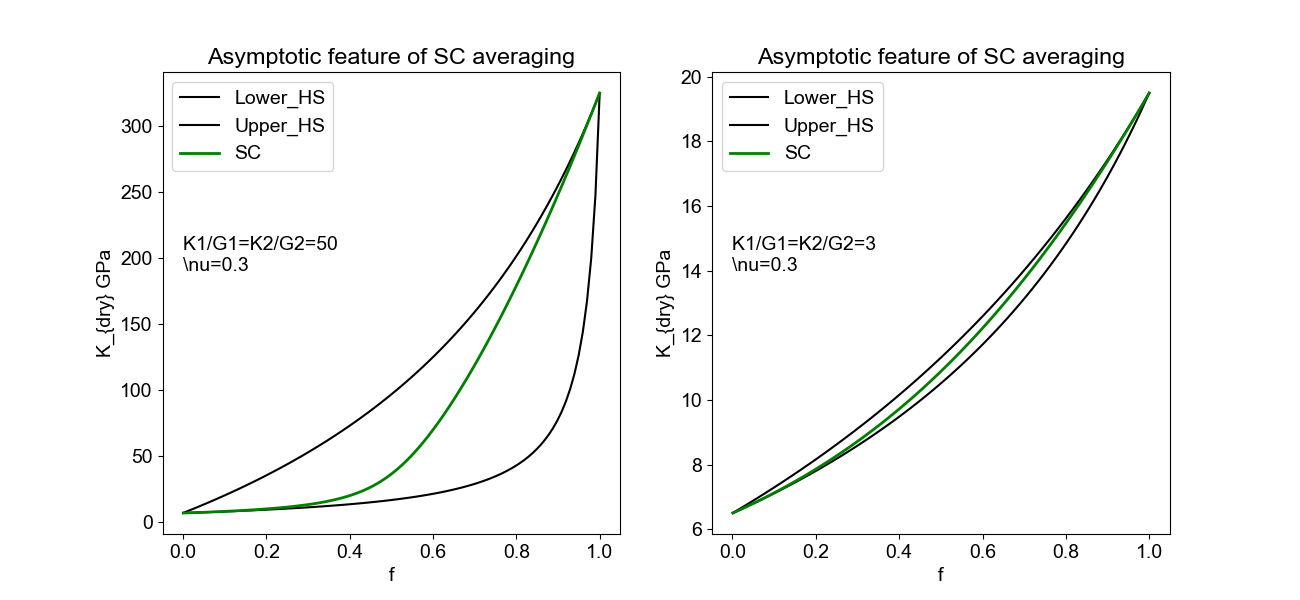
Text(0, 14, 'K1/G1=K2/G2=3 \n\\nu=0.3')
Reference: - Nemat-Nasser, S. and Hori, M., 2013. Micromechanics: overall properties of heterogeneous materials. Elsevier. - Iwakuma, T. and Koyama, S., 2005. An estimate of average elastic moduli of composites and polycrystals. Mechanics of materials, 37(4), pp.459-472.
Total running time of the script: ( 0 minutes 1.008 seconds)

