Note
Go to the end to download the full example code
Critical porosity model and Gassmann Fluid substitution
This pages gives a simple examples of using the classes EM and Fluid of rockphypy to compute Critical porosity model and perform Gassmann Fluid substitution.
# Importing aux libraries
import numpy as np
import matplotlib.pyplot as plt
plt.rcParams['font.size']=14
plt.rcParams['font.family']='arial'
import rockphypy # import the module for rock physics
from rockphypy import EM # import the "effective medium" EM module
# import the 'Fluid' module
from rockphypy import Fluid
Critical porosity model
Remember Nur’s hypothesis: There is a critical (structure-dependent) porosity at which the framework stiffness goes to zero. The simple yet powerful critical porosity model is defined as:
where \(K_0\) and \(\mu_0\) are the mineral bulk and shear moduli.
Gassmann Fluid substitution
Compute dry frame moduli using rock physics models such as critical porosity model is straightforward as shown above. To compute saturated elastic moduli, Gassmann’s explicit equations for fluid substition can be applied. Gassmann’s relations not only allows us to perform fluid substition (when one fluid is replaced with another), but to predict saturated-rock moduli from dry-rock moduli, and # vice versa.
Here we show how to compute saturated moduli via Gassmann thoery.
The equation we are gonna use is
This is one of the equivelent expressions of the well known GS-Biot theory for fluid substitution:
Now Let’s firstly estimate the effective dry-rock and water saturated moduli # using critical porosity model. Assume that the rock is Arenite with 40% critical porosity.
# plot
# sphinx_gallery_thumbnail_number = 1
plt.figure(figsize=(6,6))
plt.xlabel('Porosity')
plt.ylabel('Bulk modulus [GPa]')
plt.title('V, R, VRH, HS bounds')
plt.plot(phi, K_dry,label='dry rock K')
plt.plot(phi, Ksat,label='saturated K')

plt.legend(loc='best')
plt.grid(ls='--')
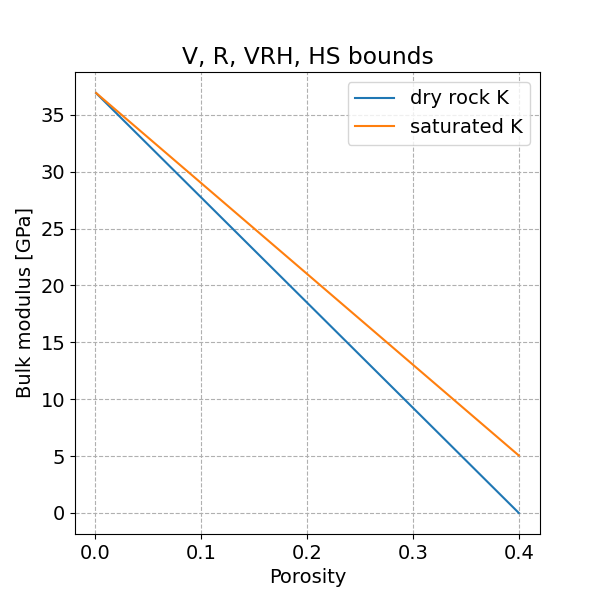
We can see from the figure that effective bulk modulus increases when the rock is saturated.
Total running time of the script: (0 minutes 0.592 seconds)

