Note
Go to the end to download the full example code
Hertz-Mindlin and reduced shear factor
import numpy as np
import matplotlib.pyplot as plt
plt.rcParams['font.size']=14
plt.rcParams['font.family']='arial'
import rockphypy # import the module for rock physics
from rockphypy import GM # import the "effective medium" GM module
Hertz-Mindlin thoery
Hertz estimated the effective bulk modulus of a dry, random distributed, identical-sphere pack as:
Mindlin (1949) showed that if the spheres are first pressed together, and a tangential force is applied afterward, slip may occur at the edges of the contact. The normal stiffness is the same as in the Hertz solution, while the effective shear modulus of a dry, random distributed, identical-sphere pack given by Mindlin is:
\(C\) is the coordination number being the average number of contacts per particle. \(P\) is the hydrostatic confining pressure, \(G\) and \(\nu\) are the shear modulus and Poisson’ ratio of grain material, respectively.
Reduced shear factor
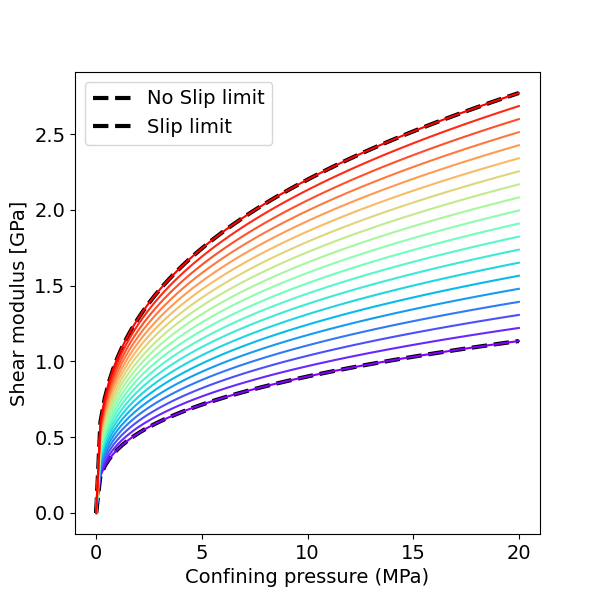
There are experimental data show that bulk modulus of unconsolidated sand can be well predicted using Hertz Mindlin model, but the predicted shear modulus don’t match the lab data. Walton’s model is limited to no-slip and slip grain packs, in order to account for the fact that the friction between grains may in the state between no-slip and slip limits, Duffaut et al.(2010) are given as an average of the no-slip and slip contacts. A methodology that gives the same result is the binary mixing factor described in Bachrach and Avseth (2008). The factor from Bachrach and Avseth (2008) treats the grain assembly as a mixture of no-slip and slip contacts, instead of having all contacts at an intermediary state. As a result, the effective bulk modulus of the pack remains the same, but the expression for the effective shear modulus becomes
Examples
The effect of reduced shear factor on HM modelling
# plot
plt.figure(figsize=(6,6))
plt.xlabel('Confining pressure (MPa)')
plt.ylabel('Shear modulus [GPa]')
plt.plot(sigma, G_rough,'--k',lw=3,label='No Slip limit')
plt.plot(sigma, G_smooth,'--k',lw=3,label='Slip limit')
# HM modelling for a discrete set values of reduced shear factors
len=20
f= np.linspace(0,1,len)
colors = plt.cm.rainbow(np.linspace(0, 1, len))
for i, val in enumerate(f):
    _,G= GM.hertzmindlin(K0, G0, phic, Cn, sigma, val)
    plt.plot(sigma, G, color=colors[i])
plt.legend(loc='best')
<matplotlib.legend.Legend object at 0x7f70f46dd580>
Walton’s theory
Mindlin assumes a partial slip in the contact area. In constrast, Walton assumes that normal and shear deformation of a two-grain combination occur simultaneously. The slip occurs across the whole area once applied tractions exceed the friction resistance. Spheres maybe infinitely smooth (perfect slip) or infinitely rough (no slip). For the smooth-spheres dry pack:
The rough limit is the same as Hertz-Mindlin’ theory.
Noticed that the function GM.hertzmindlin and GM.walton yield exactly the same result as we include the reduced shear factor in both functions. But remember the difference between Hertz-Mindlin’s approach and Walton’ appraoch and their relations, as above decribed.
print('HM result:', GM.hertzmindlin(30,20,0.4,6,10,0.5))
print('Walton result:',GM.Walton(30,20,0.4,6,10,0.5))
HM result: (0.7876744416165334, 0.7816154074502524)
Walton result: (0.7876744416165333, 0.7816154074502523)
Note that in many experiments on natural sands and artificial granular packs, the observed dependence of the elastic moduli on pressure is different from that given by the Hertz–Mindlin theory. This is because the grains are not perfect spheres, and the contacts have configurations different from those between perfectly spherical particles. Hertz–Mindlin theory also fails to incorporate the spatial heterogeneity of stress and strain within the random grain pack
Reference:
Mavko, G., Mukerji, T. and Dvorkin, J., 2020. The rock physics handbook. Cambridge university press.
Bachrach, R. & Avseth, P. Rock physics modeling of unconsolidated sands: Accounting for nonuniform contacts and heterogeneous stress fields in the effective media approximation with applications to hydrocarbon exploration Geophysics, Society of Exploration Geophysicists, 2008, 73, E197-E209
Duffaut, K.; Landrø, M. & Sollie, R. Using Mindlin theory to model friction-dependent shear modulus in granular media Geophysics, Society of Exploration Geophysicists, 2010, 75, E143-E152
Total running time of the script: (0 minutes 0.188 seconds)

